I felt that my feet were wet. I didn’t think much of it at first. Then there was shouting. Two men started fighting. I didn’t know what was happening.” Samuel, 23, is an Eritrean migrant in Lampedusa. “Half an hour later, the water was over my feet. People were using everything they had to get the water out. Women were crying. Even men were crying. Some were praying. I was praying. I really thought I was going to die.”
News
To the rescue...
2013-10-02
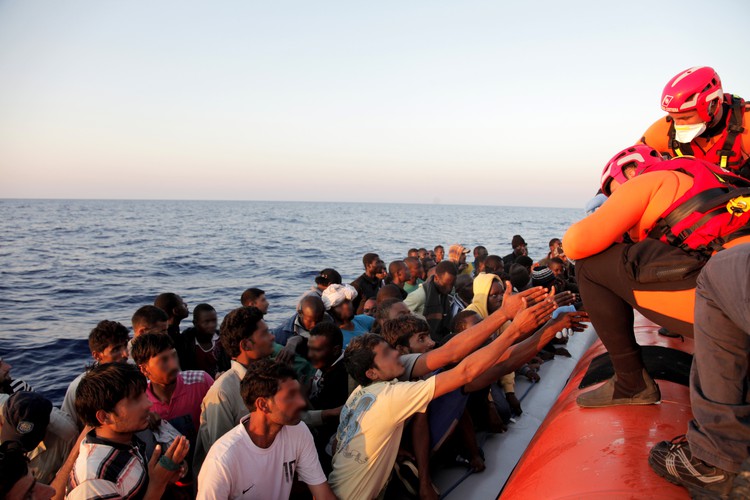
Samuel’s story is far from unique. Having paid a smuggler for passage by sea to Italy, the flimsy fishing boat he and around 70 others were sailing in had started taking on water. The engine was still working, the sea was calm, the weather good. But the worst had happened. What started as the final climax to a gruelling odyssey across a continent had gone terrifyingly wrong. Like so many migrants attempting to cross the Mediterranean on over-packed and dilapidated fishing boats, he and his fellows were in desperate need of help. The fighting was about whether or not to use send a distress signal. The ‘captain’ had a satellite phone for use as a last resort but panic had set in on board.
Despite the name, most search-and-rescue (SAR) cases in Lampedusa do not start with search. Around 90% of cases are initiated by distress calls, either via the international distress frequency, (‘May Day’ Channel 16) or to a pre-arranged civilian on the mainland to raise the alarm; often a priest or member of a migrant-friendly organisation who then contacts the coast guard. This sets the SAR wheels into motion. From here on the key words are time, information and communication.
On call…
Lieutenant Giuseppe Cannarile sits in a small office by Lampedusa harbour. The room is simple, sparsely furnished, functional. Cannerile heads the operations centre on Lampedusa for Guardia Costiera — the Italian coast guard. The centre’s main role is to manage the rescue of mi-grants in the seas off the Island. To maintain rapid-response readiness, he manages his fleet of Coastal Patrol Vessels (CPVs) and Offshore Patrol Vessels (OPVs) as well as the crews and other personnel needed to perform the coast guard’s vital functions. At least one vessel is kept on five-minute stand-by, another is available for deployment in 15-minutes. Each CPV has a crew of nine: five to man the craft, two rescue swimmers, a doctor and a nurse.
When a call comes in, the questions are standard — number of people, what medical needs they have, number of women and children and, of course, location. And herein lies the first hurdle. Although the distance and general area can be found through triangulation, to determine the number and type of vessels to send, along with any aerial assets, the precise location has to be determined by the satellite phone company. And this takes time. The rescue crews are on their way, but to find the exact location the distress was sent from typically takes about half an hour. The most commonly used company is based in Saudi Arabia and if it is night time there, or a public holiday, it can take longer. Moreover, the location will also be that from which the signal was sent, which is unlikely to be where the boat will be found. If the cause of distress is engine failure, as it often is, the boat will drift and even with years of maritime experience, currents, tides and wind conspire to add up to an hour to the time it can take to find and reach the target.
But the location also carries with it an-other important factor. Cannarile’s team have coordinating authority for Italian territorial waters, up to 24 nautical miles from Lampedusa. Beyond that, in international waters, coordination is taken over by the Maritime Rescue Coordination Centre (MRCC) in Rome. The MRCC takes all the strategic decisions in such an operation. Whether to instruct a commercial vessel in the area to intercept until the coast guard arrives, which assets to dispatch and, crucially, which country is responsible. The world’s seas and oceans are divided into search-and-rescue areas with a country responsible for each. But although this sounds straightforward, it is fraught with complications. Some countries, such as Libya currently, do not always have the capacity to respond. Others may simply be unwilling or unable to deploy resources. For this reason it is the MRCC that takes over operational command and decides which relevant national authorities, as well as any commercial or private vessels in the area, to instruct throughout the operation. Around 20% of rescues involve merchant or fishing vessels in the area that can get there faster (as in Samuel’s case). This is done through constant communication between a network of other coordination centres — local, sub-regional, regional, national and international.
Into action…
The term search and rescue conjures up sensational images of a life-and-death battle against raging elements, of helicopters winching the injured to safety, of people being snatched from the jaws of death. But while such dramatic scenes are played out, most cases are less eventful. Once spotted, the interception and transfer of passengers require a combination of seamanship, experience and well-practised standard operating procedures.
The approach is very important; care is taken to shield the target boat from wind and waves by approaching broadside, sometimes with a CPV on either side of the boat in distress to maximise shelter; if the migrant boat has lost engine power it will drift sideways into oncoming waves rather than bow-first; safest is to approach parallel, bow-to-bow, stern-to-stern.; most importantly, keep the passengers calm.
When seeing a rescue boat, the temptation for distressed passengers is to rush to one side — this may capsize an already unsafe craft and cause a bigger emergency. Hence, throughout the approach, “warping” (or tying the boats together) and transfer, passengers are constantly instructed to remain calm and to stay seated. If the craft is unstable they may need to be repositioned while they wait to transfer to the CPV. This is done one-by-one. Though frustrating, it is the safest way and prevents further risk to rescuers and rescuees alike. Passengers may be panicking. In some cases they may have been drinking sea water for several days, causing psychotic symptoms.
Transfer can be a painstaking process as first the priority cases are identified (babies, children, pregnant women, the elderly, those with medical needs) and transferred first. Factors such as the heights of the respective vessels (especially when transfer-ring to or from an OPV or merchant vessel), the technical condition of the migrant boat and — always — the weather and sea conditions, determine how the transfer is con-ducted. In emergency situations climbing nets can be draped over the side of the CPV. Rescue swimmers are always present.
Search…
Major Enrique Garcia Sanchez sits by a radar screen. Next to him sits a FLIR operator. The FLIR (Forward-Looking Infra Red) camera is just one part of a range of surveillance equipment available to Major Sanchez and his crew as they scour the waters of the Strait of Sicily from 4,000 feet.
There is a common misconception that the maritime authorities know everything that is happening in the Med; that one of the world’s busiest waterways is completely covered by surveillance and tracking technology. This is not the case. The curvature of the Earth makes total radar coverage impossible, weather conditions and cloud cover can render satellite images useless and they are only available when the satellite is overhead and then there is a delay. AIS, the Automated Identification System for shipping, applies only to large commercial vessels and all EU fishing boats over 16 metres. But that is not what Guardia Civil are looking for. Migrant boats are small and, as a rule, they do not want to be detected. Couple this with the fact that the Mediterranean has a surface area of 2.5 million square kilometres and the proverbial “needle in a haystack” springs to mind.
Although only around 10% of Lampedusa’s SAR cases are initiated this way, no chances are taken. Aerial surveillance remains a key element of Joint Operation Hermes and Frontex has deployed this Spanish plane to comb the area to spot the tiny specs that will start the wheels of SAR in motion once more — another unsafe boat, another Samuel, another signal to Lieutenant Cannarile. Another day’s work for Guardia Costiera.