Since the beginning of the operational phase of Joint Operation (JO) Indalo 2011, the number of pregnant women and minors detected increased compared with the results of JO Indalo 2010.
News
Indalo Detects New MO
2011-10-05
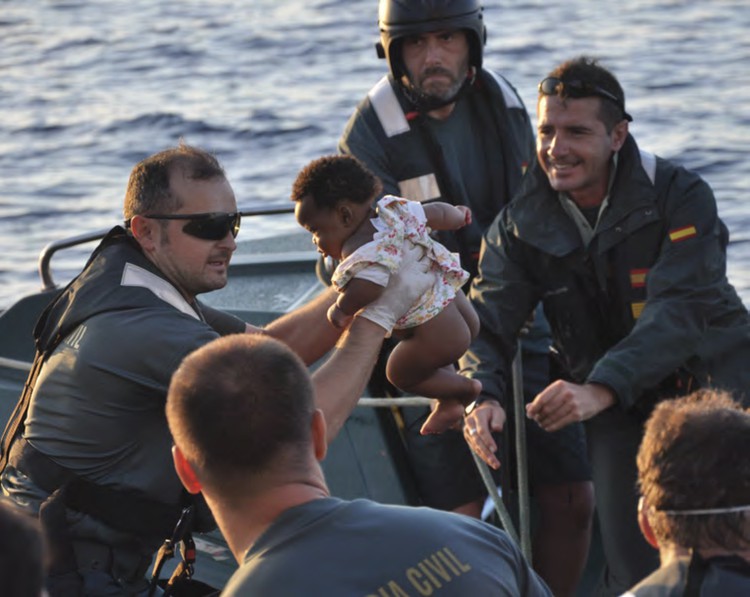
This increase in the number of detected (pregnant) females and unaccompanied minors might be linked to the aim of exploiting the benefits introduced by a reform of immigration law (approved by the Spanish Parliament and in force since the middle of December 2009). The net effect is that the Spanish government is restrained from returning these migrants. According to the US State Department’s 2011 Trafficking in Persons Report, Morocco is considered a source, destination, and transit country for men, women, and children who are subjected to forced labour and sexual exploitation.
The intercepted women mainly claimed to be nationals of Nigeria, Ivory Coast and Cameroon whilst the minors, once in the care of the Spanish regional government, were identified as being mainly Nigerian, Algerian and Congolese nationals.
Men, women, and an increasing number of children from sub-Saharan Africa enter Morocco voluntarily but illegally with the assistance of smugglers. Once in Morocco, some of the women and older girls are coerced into prostitution or, less frequently, forced into domestic service. Most sub-Saharan African migrants reach Oujda, Morocco, generally via Algeria.
The traffickers are the “chairmen,” or leaders, of abandoned dwellings where Indalo Detects New MO groups of sub-Saharan diaspora have taken residence, organised by tribe or nationality. Some of the female migrants in Oujda are subsequently forced into prostitution once they reach Europe. Trafficking and smuggling are organised in the country of departure, often with the assistance of family members, and some networks in Africa have connections in Europe. Most female sex trafficking victims are Nigerian.
Intelligence gathered in the framework of JO Indalo also shows that some female migrants are forced by facilitators to become pregnant and beg in Oujda, as a pregnant woman or a woman with a baby is less likely to be deported.
Most of the women detected by JO Indalo were between the fifth and ninth month of pregnancy; therefore due to humanitarian reasons they cannot be forcibly returned to their country of origin.
Some irregular sub-Saharan male migrants detected claimed to have paid a higher fee to facilitators in order to be related to one of the pregnant women on board the vessel with the objective of claiming family reunification under Spanish law.
Moreover, with regard to land routes from origin countries to departure areas, the migrants stated that the women need to earn money in order to avoid sexual harassment or violence at police controls or by facilitators along the travel route.
It was also stated that sub-Saharan migrants had made contact with other African (non-Maghreb) men, in order to forge a link with Moroccan facilitators. These types of intermediary appeared after sub-Saharans asked for help to make the sea crossing towards Spain. They appeared at the coastal places close to typical departure points.
For the first time in the framework of JO Indalo, almost all the irregular migrants detected onboard a boat refused to cooperate or to provide information about their departure point, facilitators involved or arrangements for the sea crossing.
The statements provided by some of the migrants raised the possibility of the involvement of Nigerian and Ghanaian nationals in facilitating migration towards the Spanish coast.
It is believed that the migrants were implicitly coerced not to cooperate with the Spanish authorities.
The facilitators, ma inly Nigerian and Ghanaian nationals, are known for retaining one or more children in the areas of departure in order to ensure that the migrants do not cooperate with the EU Member State authorities, only allowing the children to board, in the following boats, upon receiving confirmation that the migrants succumbed to their demand(s).
Intelligence suggests that Moroccan facilitators are also sexually exploiting sub-Saharan minors stranded in the departure countries.