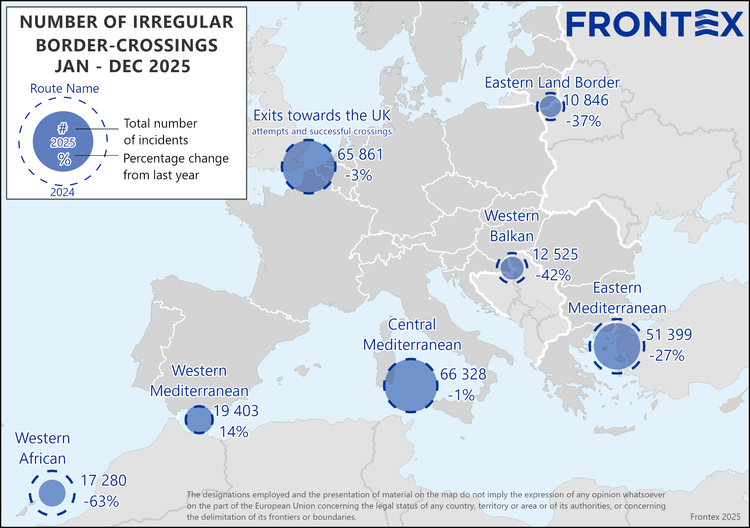
Initial consolidated figures from Frontex, the European Border and Coast Guard Agency, show detections of irregular border crossings at the EU’s external borders fell by over one-quarter (26%) in 2025 to almost 178 000. This is less than half the total recorded in 2023 and the lowest level since 2021.
The decrease is a significant development, yet Frontex warns that the situation at Europe’s borders remains uncertain. Migration pressure can shift quickly between routes, shaped by conflict, instability and smuggling networks. The European Union is also already coping with attempts by hostile actors to exploit migration flows to put pressure on the EU’s external borders.
Looking ahead, 2026 will be a pivotal year for European border management. The EU Pact on Migration and Asylum will become fully applicable in June, marking the most far-reaching reform of Europe’s migration and asylum system in years. This will coincide with major changes to European border management, including the full rollout of the Entry/Exit System (EES) and the planned launch of the European Travel Information and Authorisation System (ETIAS) later in the year.
If there is no major geopolitical escalation in the EU’s immediate neighbourhood, irregular migration towards Europe across land and sea borders could continue the downward trend seen since 2023. This will depend on sustained cooperation with countries of origin and transit, and on Europe’s ability to stay ready for sudden shifts.
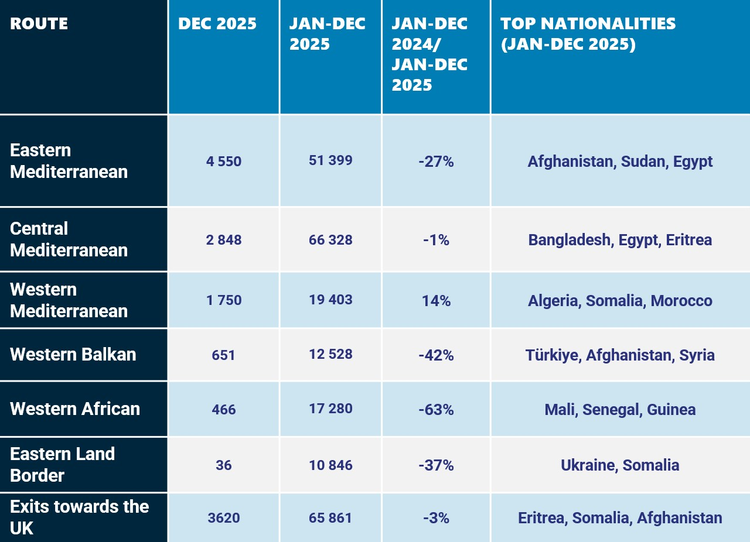
In 2025, the Central Mediterranean remained the most active migration route into the EU, with detection levels broadly in line with 2024. Departures from Libya remained a key factor shaping movements towards Italy.
On the Eastern Mediterranean route, detections fell overall, continuing a downward trend. Within this route, one corridor stood out: crossings from eastern Libya to the island of Crete more than tripled, showing how pressure can shift quickly even when the broader regional picture points to a decrease. The Western Africa route saw the steepest declines, with detections down by around two-thirds, driven by sharp drops in departures from Mauritania, Morocco and Senegal.
Along the Western Balkans route, detections also fell markedly, supported by heightened security measures and close cooperation with Frontex, which is present in the region. This includes the launch of a new Frontex joint operation in Bosnia and Herzegovina in November 2025, strengthening operational support on the ground. Meanwhile, the Western Mediterranean recorded an increase in detections, linked mainly to higher departures from Algeria.
Attempts detected on exit towards the UK across the Channel, which include both those who reached the UK and those prevented from leaving, continued roughly in line with 2024.
Across routes, the three most frequently detected nationalities in 2025 were Bangladeshis, Egyptians and Afghans. Libya remained the main country of departure for almost all major nationalities that recorded increases, underlining its continued central role in movements towards Europe across the Central Mediterranean.
Frontex works side by side with national authorities through joint operations, aerial and maritime surveillance, technical support and shared situational awareness. Cooperation with partner countries beyond the EU also plays an important role, particularly in the Western Balkans, where closer operational cooperation has helped reduce pressure and disrupt smuggling networks.
At sea, the risks remain severe, with criminal smuggling gangs often forcing people to attempt dangerous crossings in overcrowded and unseaworthy boats. According to estimates from the International Organization for Migration, at least 1 878 people lost their lives in the Mediterranean in 2025, compared with 2 573 the previous year. Frontex planes and vessels support national authorities by detecting boats in danger and sharing this information in real time, helping improve situational awareness, and search and rescue preparedness.
* Note: The preliminary data presented in this statement refer to the number of detections of irregular border crossings at the external borders of the European Union. The same person may be detected crossing the border several times in different locations at the external border.