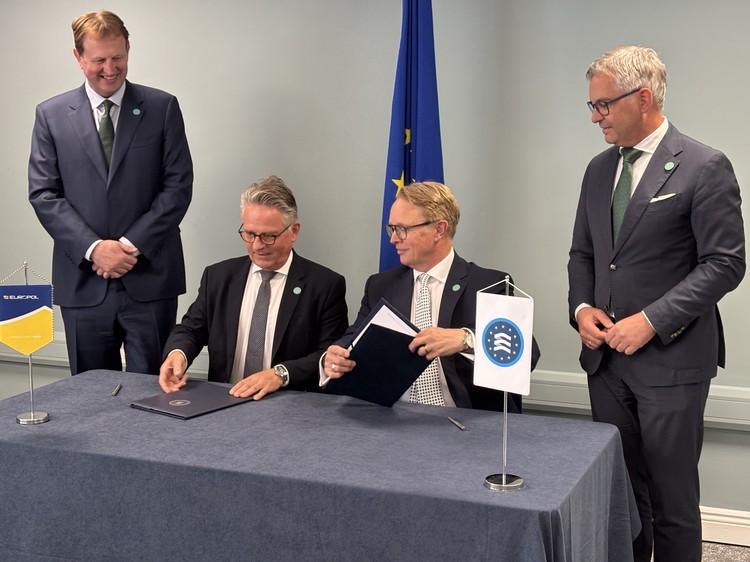
Frontex and Europol have signed a new working arrangement to step up the fight against migrant smuggling, human trafficking, terrorism, and other cross-border crime. The agreement sets out how the two EU agencies share information, work together in operations, and support national authorities at the EU’s external borders and across Europe, with strong safeguards for fundamental rights and the protection of personal data.
The new working arrangement replaces the agencies’ 2015 cooperation agreement, bringing the partnership in line with their updated mandates and current EU data protection law. It includes specific rules and safeguards for any exchange of personal data, which can take place only under strict conditions. The arrangement takes into account the recommendations of the European Data Protection Supervisor.
The working arrangement was signed by Hans Leijtens, Executive Director of Frontex, the European Border and Coast Guard Agency, and Jürgen Ebner, Acting Executive Director of Europol, the European Union Agency for Law Enforcement Cooperation. It takes effect the day after signing.
Border management and the fight against serious and organised crime are complementary and interconnected, as transnational organised crime groups are primarily responsible for the smuggling of persons and illicit goods across the external borders. Closer cooperation between the EU agency responsible for border management and the EU agency responsible for combating serious organised crime helps EU Member States respond to these threats more effectively.
In December 2025, for example, weeks of Frontex maritime monitoring, in close cooperation with Europol, supported a Greek-led investigation that ended with the interception of a drug-smuggling vessel in the Caribbean and ten arrests. The new arrangement strengthens the basis for cooperation of this kind; it also supports the rollout of EU rules on migration and border management under the Pact on Migration and Asylum, which took effect on 12 June 2026.
The signing took place in Dublin during the informal meeting of EU Justice and Home Affairs ministers, held under Ireland’s Presidency of the Council of the European Union. It was witnessed by Magnus Brunner, European Commissioner for Internal Affairs and Migration, and Jim O’Callaghan, Ireland’s Minister for Justice, Home Affairs and Migration. The full text of the working arrangement is published on the Frontex website.
Under the working arrangement, Frontex and Europol will strengthen cooperation in four main ways:
1) Sharing information to stop criminal networks
The agencies exchange information to fight cross-border crime. This can include operational personal data of individuals suspected of being involved in cross-border crime, for example people suspected of involvement in migrant smuggling, whose actions put migrants’ lives at risk. Frontex assesses each request for transfer received from Europol against the established criteria, and shares data only where it is justified that the transfer is strictly necessary and proportionate for Europol’s tasks. The data may only be used for the purpose for which it was shared; any further use must be authorised by the agency that shared it and be compatible with that original purpose. The agencies will report back to each other on how the data is used, and the detailed rules governing these exchanges will be reviewed at least once a year.
2) A shared picture of what is happening at the borders
The agencies will cooperate through EUROSUR, the European Border and Coast Guard’s framework through which national authorities and Frontex exchange border-related information, including with other relevant EU agencies and bodies. Under detailed rules to be agreed between the agencies and compiled in a dedicated cooperation plan, Frontex will establish and share specific situational pictures with Europol, helping both agencies and national authorities spot developments, assess risks, and plan their response. The situational pictures may include only very limited personal data: ship and aircraft identification numbers.
3) Working together in operations
Frontex and Europol will coordinate their work in joint operations and in EU-wide actions against cross-border crime, including under EMPACT, the EU’s joint framework for fighting serious and organised crime. The agencies will also exchange experts and liaison officers, train staff together, and cooperate on research and innovation to counter new security challenges.
To steer this work, the agencies will hold regular high-level meetings and adopt a joint cooperation plan, keeping the arrangement under continuous review.
All activities under the working arrangement will be carried out in full compliance with fundamental rights, including the protection of personal data. The Fundamental Rights Officers of both agencies will monitor activities under the arrangement and support each other’s work, and the two agencies’ data protection officers will cooperate closely to make sure data protection principles are applied consistently.
The European Commission approved the arrangement on 8 July 2026, as required by EU law, and the European Parliament and the Council will be informed by Frontex in line with the EBCG Regulation.
Frontex, the European Border and Coast Guard Agency, supports EU Member States and Schengen-associated countries in managing the EU’s external borders and organising returns. Upon a Member State’s request, Frontex can coordinate joint operations, deploy officers and equipment, and provide information and risk analysis to support decision-making. Frontex is bound by EU law, including the Charter of Fundamental Rights, and its activities are monitored by an independent Fundamental Rights Officer. The Agency’s compliance with the data protection framework is supervised by the European Data Protection Supervisor. Learn more about Frontex at frontex.europa.eu.
Europol, the European Union Agency for Law Enforcement Cooperation, supports EU Member States in preventing and fighting serious and organised crime, cybercrime, and terrorism. From its headquarters in The Hague, Europol provides criminal analysis, coordinates cross-border investigations, and acts as a hub for the exchange of criminal information between law enforcement authorities. Learn more about Europol at europol.europa.eu.
Note: This working arrangement is an administrative framework for cooperation. It does not create new legal rights or obligations under EU, national or international law.