Nothing is easy in deep snow. The simple act of walking is rendered impossible without snow shoes. Other indispensable equipment includes the right clothing, from socks and underwear to gloves and sunglasses, and of course the essential compass and map. Only then, given the right training, do you stand a chance against the elements. Hence the first day of cold-weather survival training for air crews starts with the basics — a run-through of clothing and equipment.
News
Above the snowline — cold-weather survival training for air crews
2013-04-15
Orienteering is an activity that often looks straightforward. Nonetheless, even for experienced air crews a back-to basics approach to the skill is part of the programme for learning the rudiments of survival in the bleakest of conditions. And so the five trainees spent the first half-day session of their training course brushing up on the basics — how to find the azimuth (the angle relative to north), determining their position and navigating a route to civilisation. Only then are they ready to take their first steps in the alpine landscape of Passo Rolle in the Italian Dolomites.
Passo Rolle and its environs are nestled in picture-postcard scenery much beloved of hikers and naturalist in summer and skiers in winter. Its 1984-metre altitude guarantees it good winter-sports weather to go with its stunning views. But its beauty belies hidden dangers and it is no coincidence that Passo Rolle is also home to a Guardia di Finanza mountain survival school. And the air crewmen are not there to enjoy the scenery.
Mountain survival is a serious business and the rescuers instructing these border-guard teams know only too well, and from first-hand experience, how deadly the mountains can be: sudden changes of weather, blinding blizzards, hidden pit-falls, all conspire to catch out the unprepared and they have sobering tales of what can happen to people who are caught off guard, or are ill-prepared. And swapping similar tales from their widely divergent portions of the EU external border becomes a quick ice-breaker for the five crewmen thrown together for the course. But there is much more to the course than exchanging experience. It is a first-of-its-kind survival training course, run by Frontex at the request of the Member States involved — Finland, Germany, Greece, Poland and Romania.
Common Training Standards
Cold-weather survival training is one of a raft of requirements set out in the Frontex Air-Crew Training Manual — a comprehensive breakdown of all the requirements for full deployability of helicopter air crews in joint operations that sets common training standards for both national and Frontex training. It also details the contents of Frontex training courses, from Crew Resource Management to Air-Naval Tactical Coordination to “Special Qualifications” in the use of night-vision goggles, forward-looking infrared (FLIR) systems and formation flying among others. It also outlines survival training for various environments — mountain, sea, desert and cold-weather. European Border Guard Teams have to be prepared to operate in a wide range of environments for potential deployment anywhere on the EU external borders.
Although it is unusual for Frontex to organise training for individual personnel, it can be arranged on an ad hoc basis at the request of Member States, as in this case. And the Manual clearly sets out the content to be covered — survival techniques, equipment and material, topography and orientation, first aid and (as the climax of the event) an overnight stay in a cold-weather environment. And back at the training centre the crewmen learn the ropes, literally.
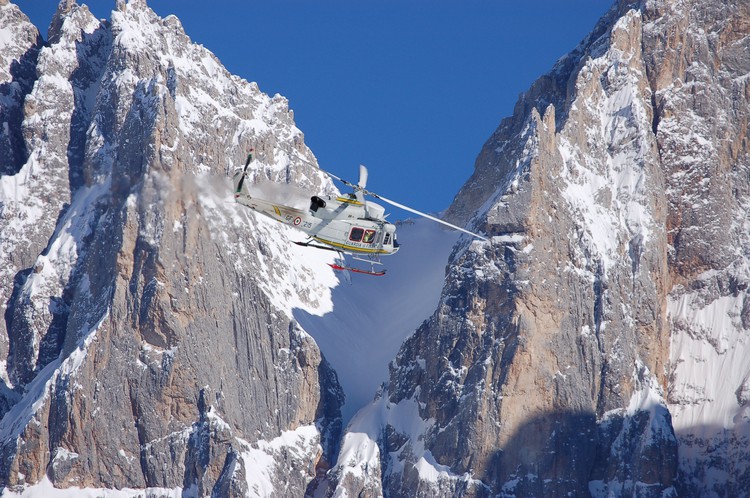
The tying of the necessary knots for a safe winching exercise is supervised by the Guardia di Finanza instructors before trainers and trainees set off by helicopter for the hills. Jumping just a metre from a helicopter into metre-deep snow looks easy but is a sharp introduction to the realities of winter weather. With nothing to hold onto or push against it is all but impossible to get upright without help. And helping each other is a key element of the exercise. Teamwork is paramount if all are to survive, and that principle extends equally to the orienteering exercise. Knowing the azimuth, the target and the direction of magnetic north are all essential, but useless without cooperation. Walking through snow is like walking in a desert — it is very easy to veer off course and a small deviation can have serious consequences. For this reason there is a walking formation. The crew member at the front leads the way closely followed by the second person, sticking literally to his footprints to maintain as straight a line as possible. A dozen or so metres further behind a second compass-bearer constantly measures the azimuth and ensures the line is straight and on target, constantly calling ahead to steer a steady course. It is slow going. The action of walking in snow shoes tires the legs and back quickly and breaks are a rare luxury.
Eventually the instructors find a suitable spot to practise shelter construction and the airmen get down to business digging snow holes, as prescribed in the theoretical training, i.e. with a deeper trench at the opening to trap the cold air and leave the warm inside. Another pair meanwhile work on a vertical shelter with a roof of branches, more suitable where there is an insufficient vertical snow face to dig into. The exercise is successful and after more orienteering practice the trainees undergo the hair-raising air-lift to the helicopter for the return flight to the training centre and preparations for the next day’s challenges.
After the full course and compulsory bivouacking and overnight experience they will all be certified in basic winter survival. Some will have other survival or operational training ahead before they can be considered fully-fledged members of the EBGT pool and ready for assignment anywhere, anytime.