Frontex has
resumed accepting new cases under the EU Reintegration Programme (EURP) on 16
November 2026, six weeks after new admissions were suspended when demand
for reintegration assistance exceeded the funding available for 2026.
Practical information for returnees:
If you are a person with a return decision who received pre-departure
counselling about EURP support, what you can expect depends on when you
departed to your home country:
If
you departed on or before 10 October 2026: competent European
national authorities or the Reintegration Partner may submit an
application on your behalf until the end of November 2026.
If
you departed between 11 October and 15 November 2026: you are not
eligible for support through the EURP. Please contact the competent
European national authority to check if you are eligible for a different
reintegration programme.
If
you depart on or after 16 November 2026: you are eligible for
support through the EURP but only the competent European national
authority may submit an application on your behalf before and up to within
a maximum of seven (7) calendar days of your departure.
Reintegration Partners are not authorised to submit new applications for
returnees departing on or after this date.
Please note: Eligibility for EURP assistance depends
on programme criteria and deadlines, and EU Member States make the final
decision on referrals.
For case-specific inquiries or complaints, please contact
the authority that facilitated your return or email eurp@frontex.europa.eu.
Reintegration
assistance refers to the support provided to migrants returned to their
countries of origin. In accordance with its mandate, defined in the legal basis, Frontex supports EU
Member States and Schengen
Associated Countries in providing reintegration assistance both during the
first days following the arrival in the country of origin (post-arrival
assistance), as well as longer-term assistance up to 12 months (post-return
assistance) to help third country nationals reintegrate into their societies.
Examples of assistance provided include support with starting a small income generating activity, accommodation, medical
assistance, job counselling, education, legal services and other.
These reintegration assistance
activities and/or services are currently being implemented by Member States through
various national and EU programmes involving a broad range of partners around
the globe offering such assistance. However, the landscape of policies, practices,
and capacities in Member States for implementing reintegration assistance is
very diverse. Some Member States have built up large capacities in this area,
while others have not been able to do so due to capacity or budgetary
constraints. The implementation of the EU
Reintegration Programme as a European-wide provision of reintegration assistance with
equal standards and equal treatment for third country nationals eligible for
support aims to harmonise these efforts and ensures that all Member States can provide
reintegration assistance with equal standards to third country nationals, with
less administrative and financial obligations.
Frontex is not implementing these
activities itself. It makes use of reliable reintegration partners operating
around the globe providing post-arrival and post-return assistance. Their reintegration
services are overseen by a dedicated Quality Monitoring and Evaluation Framework.
The activities under the EU Reintegration Programme are fully financed by the Frontex budget. The objective is to support
up to 7,000 people annually, both individuals and families, depending on the
needs of the Member States and the available budget.
Not everyone can qualify for
these services. Only third-country nationals returning both voluntarily and
non-voluntarily who no longer fulfil the conditions to stay in the EU can be
qualified. They can request reintegration assistance up to 6 months after departure
from the host country.
Third country nationals with legal
stay and those under the temporary protection directive do not qualify for
reintegration assistance offered under the EU Reintegration Programme.
It is important to note that the EU Member
States and Schengen Associated Countries participating in the EU Reintegration Programme decide how the EU Reintegration Programme is implemented in
accordance with their national procedures and legislations.
Types of reintegration services
The services supported by Frontex
are divided into three packages that can be used separately or combined.
Post-arrival package
These services or activities
include the immediate assistance upon arrival in the country of origin and are
organised and coordinated between the responsible Member State and the
reintegration partner. This short-term assistance may include:
Post-return package
These services or activities
include the long-term assistance activities which can be implemented up to 12
months after the date of departure. They may consist of:
The
post-return package is always a result of collaboration between the concerned third
country national, the responsible authority in the Member States, and the
contracted reintegration partner. Together, they develop a tailor-made reintegration
plan based on the person’s personal situation and needs. In this respect,
return and reintegration counselling is crucial to ensure that the person can make
an informed decision about the future, but also to increase the quality of the
reintegration assistance implemented delivered by the local reintegration
partner.
Reintegration Assistance Tool
The case handling of the EU Reintegration Programme is done through a digital platform, called the Reintegration
Assistance Tool (RIAT), developed and owned by the European Commission. This
online tool simplifies and standardises the exchange of information on the
reintegration process to the best benefit of third country nationals,
reintegration partners and Member States. It provides an end-to-end live overview
of the case, including the application, the development and approval of a
reintegration plan, and the reporting. Also, it also serves as an important
source of data for evaluation and quality monitoring purposes.
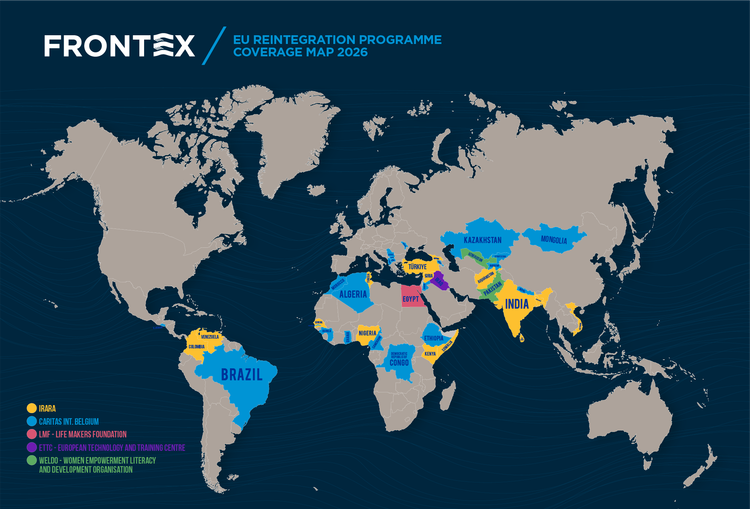
The EU Reintegration Programme is currently active in 38 countries of origin. However, this number is expected to
grow further in 2025, in line with the operational strategy on more effective returns. As
mentioned above, Frontex is not implementing the reintegration assistance,
instead it relies on the expertise of reliable reintegration partners from the
civil society sector with whom Framework Partnership Agreements were concluded.
They are:
To oversee the quality of
services, a dedicated Evaluation and Monitoring Framework is in place.
Reintegration conference
Frontex’s
Reintegration Conference is a regular event held by the Post-Return Unit (within
the Return Division) to address reintegration policies and related topical
issues in an interactive manner. It brings together authorities of EU and
Schengen associated countries, reintegration partners, the European Commission,
researchers, civil society organisations, and experts on migration.
As a unique
forum for facilitating developments in the field of reintegration, the
conference aims not only at increasing awareness of the main challenges in the
reintegration assistance but also at initiating a profound discourse on further
harmonisation of the post-return standards and their glossary across the EU.
This meaningful debate encourages reflection on current strengths and areas
with growth potential, exchange of best practices and development of key
recommendations. Moreover, it examinates the realities of the reintegration in
third countries in order to foster partnerships and create synergies where
possible.
The conference
is also the place where the concepts and innovations regarding return and
reintegration counselling are discussed, exchanged and challenged. Its format
is designed to enhance interaction through panel discussions, lectures and
workshops that address the most crucial aspects in the post-return domain.
Return and Reintegration Counselling
Return counselling, when coupled with a migrant-centred
approach, is crucial to promote voluntary
returns and reintegration programmes. It is more than organising the logistical
aspects of the return process, but takes into account the complex emotional,
social, and economic factors influencing a migrant's decision to return to his or her home country – eventually aiming for a sustainable reintegration.
A migrant-centred approach ensures that the counselling process is tailored to
individual needs and circumstances. This means providing comprehensive,
accurate, and unbiased information about the return process, conditions in the
country of origin, and available reintegration assistance.
Critically, it involves active listening and empathetic
engagement, empowering migrants to make an informed decision without coercion.
When migrants feel heard, respected, and supported throughout the counselling
process, they can take co-ownership, deciding on a better future, while
actively engaging in using all available support schemes. This, in turn,
significantly increases the likelihood of successful and durable reintegration,
benefitting not only the individual but also his or her community and the broader
society in third countries.
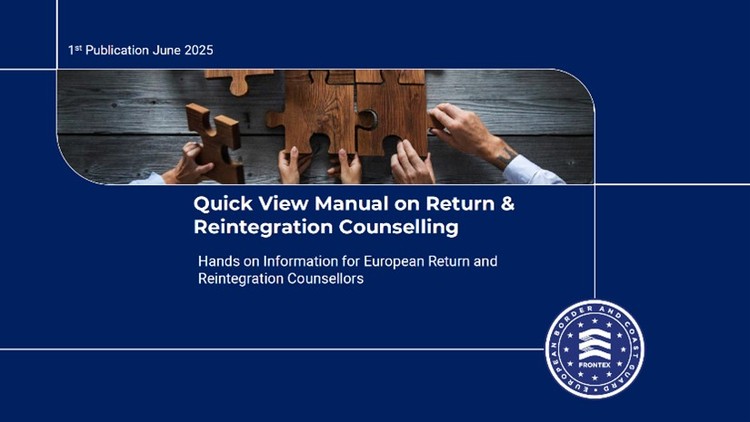
To help Return Counsellors in their daily tasks and
challenges, Frontex has developed the Quick View Manual for return and
reintegration counsellors, together with practitioners from EU Member
States. It is a practical and easy-to-use resource that covers all relevant
aspects of return counselling, ranging from communication, stress factors,
decision making, and dealing with vulnerable groups to reintegration assistance.
It contributes to Frontex’s aim to support, align, and
harmonise counselling efforts across Europe and may be used by all counsellors
regardless of their organisational background.
Country Information Sheets
(CIS) are a practical tool designed to support return and
reintegration counsellors by providing accurate, up-to-date, and
country-specific information. They help ensure consistent, efficient, and
high-quality counselling for returnees.
EU Reintegration Programme success stories
Through the EU Reintegration Programme (EURP), Frontex provides essential support to migrants returning to their home countries. This type of reintegration support is fully financed by Frontex and implemented by reintegration partner organisations. One of them is EURP, which ensures equal treatment across EU Member States by offering accommodation, medical aid, job counselling, education, and other assistance for up to 12 months post-return. Watch EURP stories.