EU external
borders: Irregular border crossings fall 25% in first two months of 2025
The number of
irregular border crossings into the European Union dropped by 25 % in the first
two months of 2025, to nearly 25 000, according to preliminary data collected
by Frontex*. While most routes saw a decrease in the number of arrivals, the
Central Mediterranean route defied the trend.
Key
Highlights:
•
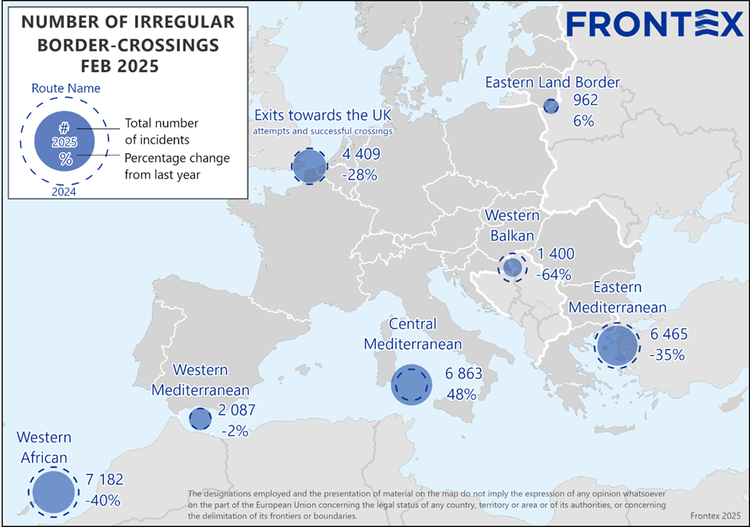
Western African route accounted for a
significant part of arrivals in January-February.
•
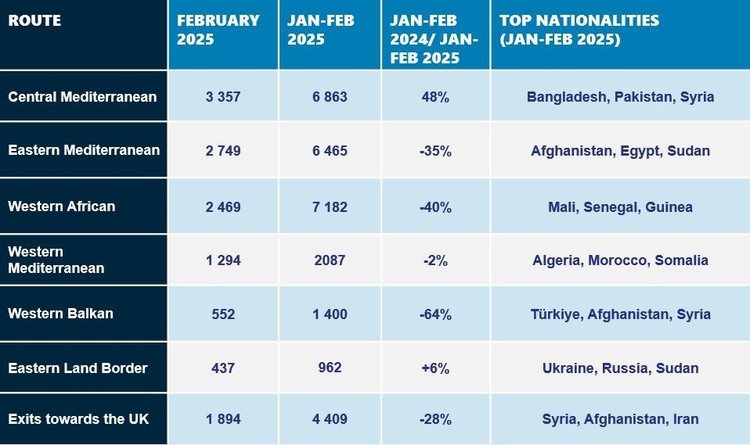
Central Mediterranean route saw the biggest rise
in arrivals (+48% year-on-year).
•
Western Balkans experienced the steepest drop (-64%).
•
Top nationalities detected: Afghan, Bangladeshi,
and Malian.
Frontex
supports national authorities in their efforts to protect Europe's borders with
2 900 officers along the EU's external borders.
Despite a 40%
decrease from last year, the Western African corridor remained the most
active route for irregular migration, with 7 200 arrivals recorded in
January-February. Most migrants came from Mali, Senegal, and Guinea.
The Central
Mediterranean route witnessed the biggest increase in the first two months
of the year, up 48% year-on-year to almost 6 900. This made it the second most
active migratory route to the EU.
Libya remains
the primary departure point on this route, with smugglers increasingly relying
on powerful speedboats to outmanoeuvre authorities. The cost of a sea crossing
varies between EUR 5 000 and EUR 8 000 per person.
Bangladeshi
nationals remain the most common nationality on this route, frequently
leveraging formal agreements between Libya and Bangladesh to enter legally for
work before embarking on the sea crossing.
By the end of
February, the Eastern Mediterranean ranked as the third busiest
migration corridor into the EU, with nearly 6 500 arrivals. However, detections
on this route were down 35% from a year ago. After peaking at around 6 700
detections in October, the pressure on this route has steadily eased amid
winter weather, with numbers dropping to 2 750 in February.
Sea crossings
continue to put migrants’ lives at great risk, with many relying on organised
criminal networks to attempt the journey. The International Organization for
Migration (IOM) estimates that 248 people died at sea in January and February. In
all of last year, this figure reached 2 300, underscoring the tragic human cost
of these hazardous routes.
On the Channel
route, the number of migrants attempting to cross into the United Kingdom
dropped by 28% compared to last year, with detections slightly above 4 400.
We
will be happy to support you in writing your story. Send us your questions
please and will see how we can help you with it.
* Note: The preliminary data
presented in this statement refer to the number of detections of irregular
border crossing at the external borders of the European Union. The same person
may cross the border several times in different locations at the external
border.