Frontex-supported returns climb in first half of 2026
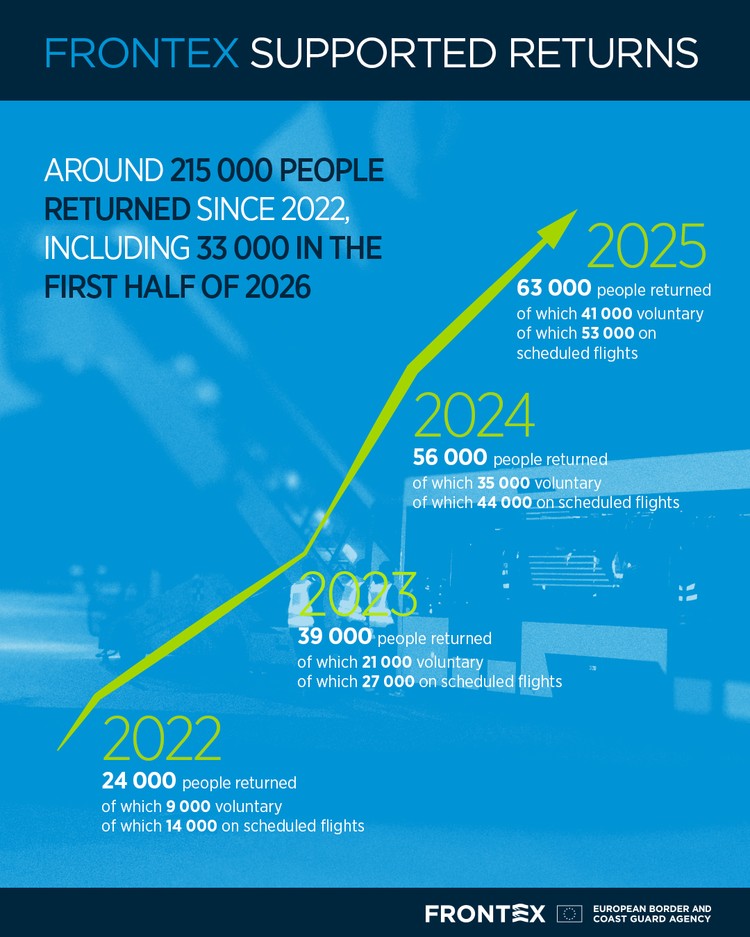
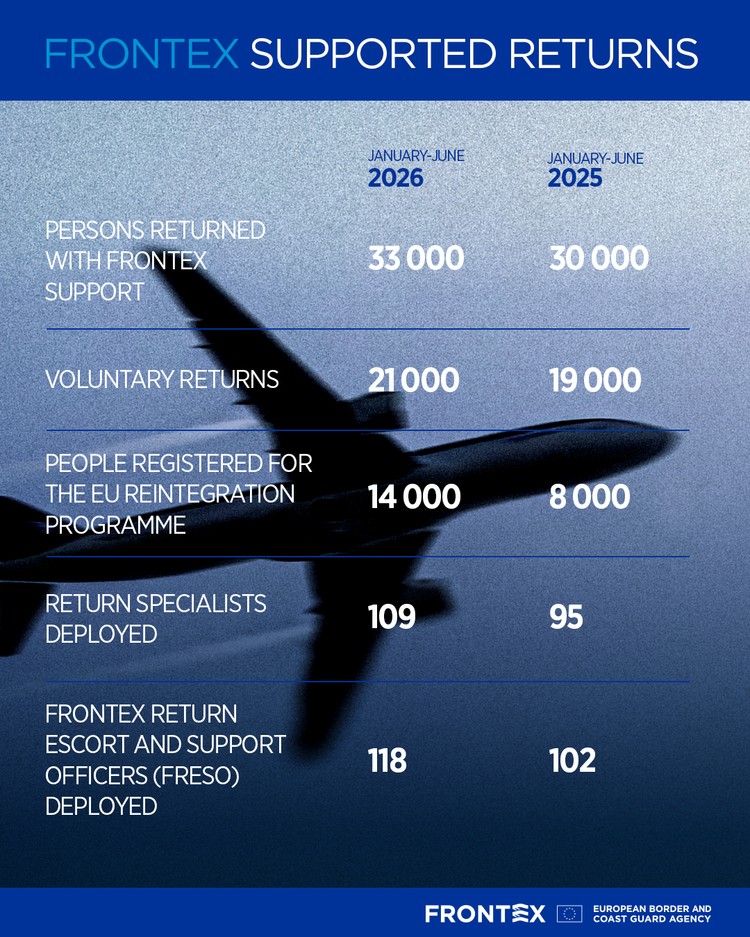
Frontex, the European Border and Coast Guard Agency, helped EU Member States return more than 33 000 people to non-EU countries in the first half of 2026, up from around 30 000 in the same period a year earlier. Around two in three of them returned voluntarily.
That takes the number of people Frontex has helped return since 2022 to around 215 000.
Some 21 000 people returned voluntarily in the first half of the year, compared with around 19 000 a year earlier. Every return that Frontex supports follows an enforceable return decision, meaning the person has exhausted their legal options to remain in the EU. In a voluntary return, the person complies with that decision and leaves with practical help and, where they qualify, financial support. In a forced return, the decision is enforced because the person has not complied with the obligation to leave. That obligation is the same in both cases.
Whether a return is voluntary or forced is decided by national authorities rather than by Frontex; however, the Agency supports both. Voluntary returns are generally more cost-effective than forced ones, which routinely require escorts, medical and monitoring staff, and in some cases dedicated charter arrangements.
Return Specialists from the Standing Corps talk to people about what returning would involve and what help is available, help national authorities manage cases in the systems used to process returns, and support obtaining from the authorities of countries of origin the identity documents required to travel. In the first half of the year, 109 Return Specialists were working across 15 Member States.
The support does not always stop when the plane lands. Around 14 000 people registered for EU reintegration assistance in the first half of 2026, up from around 8 000 a year earlier. That assistance can mean vocational training, a small grant to start a business, or counselling once someone is back in their country of origin. More than four in five of those who registered had returned voluntarily.*
*Not all the people registered under the EU Reintegration Programme (EURP) were the same people as those returned with Frontex support. Member States may also enrol other returnees for the EURP as long as they meet the eligibility criteria.
The Agency also operationally supports the departures themselves. Frontex Return Escort and Support Officers (FRESOs), also part of the Standing Corps, accompany returnees, help people through airports, and handle the administrative and logistical work behind each flight, including for voluntary returnees who need extra assistance. Over the period, 118 FRESOs were deployed across 11 Member States.
The wider legal framework for returns is also changing. The Regulation establishing a Common European System for Returns, agreed by the European Parliament and the Council in June 2026, sets out common rules for return across the EU, including by making forced return the rule where a person does not cooperate, absconds to another Member State, or poses a security risk. The Commission is expected to propose a further strengthening of Frontex’s mandate on returns, including its support to Member States, in the autumn.
A lower-carbon approach to return flights
With air travel accounting for the large majority of return operations, Frontex has been working to reduce the environmental footprint of its return flights. The Agency prioritises scheduled flights over charter flights whenever this is operationally possible. Under an agreement in place since 2023 with a major European airline, a share of the airline’s revenue from Frontex-funded flights goes towards purchasing Sustainable Aviation Fuel (SAF) and other environmental sustainability initiatives, provided that they meet the sustainability criteria set by the International Civil Aviation Organization. In the first half of 2026, this funded the purchase of over 90 tonnes of SAF, mitigating an estimated 313 tonnes of CO2 across the full lifecycle of the fuel, from production to combustion.
Frontex, the European Border and Coast Guard Agency, supports EU Member States and Schengen-associated Countries in managing the external borders of the European Union. Established in 2004, the Agency’s tasks include monitoring migratory flows, supporting border management, and assisting Member States with return activities. Frontex is building up a Standing Corps of officers who can be deployed to support national authorities on the ground. The Agency is based in Warsaw, Poland.
Top 10 nationalities of Frontex-supported returnees, January to June 2026: Türkiye, Syria, Georgia, Colombia, India, Brazil, Albania, Morocco, Nigeria, and Iraq.
Top 5 Member States by number of Frontex-supported returns, January to June 2026: Germany, France, Cyprus, Belgium, and Sweden.