Based on preliminary data available to Frontex, irregular border
crossings into the European Union fell by 37% in the first seven months of 2026
compared with the same period last year, with approximately 61 000 detections
recorded at the EU’s external borders.
These figures do not reflect the exceptional events at
the external borders in Ceuta/Spain at the end of July.
Based on the data currently available, most major migratory routes
recorded fewer crossings than in 2025. The Eastern Mediterranean and Central
Mediterranean were the busiest routes, together accounting for around 60% of
all detections currently reflected in the EU entry total. The Western African
route recorded the steepest decline, while the Western Mediterranean was the
only major route to record an increase.
The overall decrease recorded so far reflects a number of factors,
including continued cooperation with partner countries and preventive measures
in key countries of departure that have contributed to reducing departures
towards Europe.
With around 3 800 officers deployed at the EU’s external borders,
Frontex continues to support national authorities in managing Europe’s borders
and saving lives at sea. Frontex officers also continue to support Member
States in implementing the new rules under the Pact on Migration and Asylum.
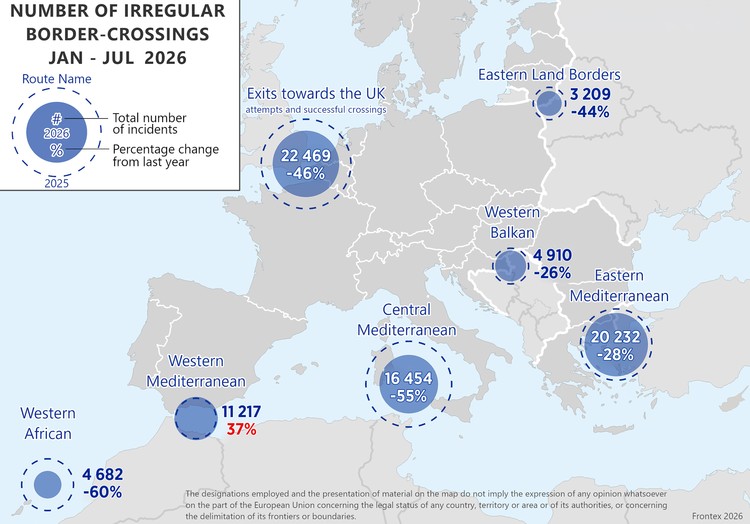
The Eastern Mediterranean was the busiest migratory route in the first
seven months of 2026, with 20 232 detections, down 28% compared with the same
period last year.
The Central Mediterranean recorded 16 454 detections, a decrease of 55%
compared with the first seven months of 2025. Libya remained the main country
of departure on this route.
The Western Mediterranean recorded around 11 500 detections and was the
only major route to show an increase based on the data currently available.
The Western African route saw the steepest decline, with detections
falling by 60% to 4 682.
The Western Balkans route recorded 4 910 detections, down 26%.
The Eastern Land Border recorded 3 209 detections, down 44%.
Separately, attempts and successful crossings of the Channel towards the
United Kingdom fell by 46%, with 22 469 detections recorded. These are counted
on exit from the EU and therefore do not form part of the EU entry total
presented above.
Figures are based on preliminary EUROSUR data and estimates available to
Frontex as of 4 August 2026 and may be subject to subsequent revision.
The data presented in this
statement refer to detections of irregular border crossings at the external
borders of the European Union. The same person may be detected more than once
when crossing the external border at different locations or on different occasions.