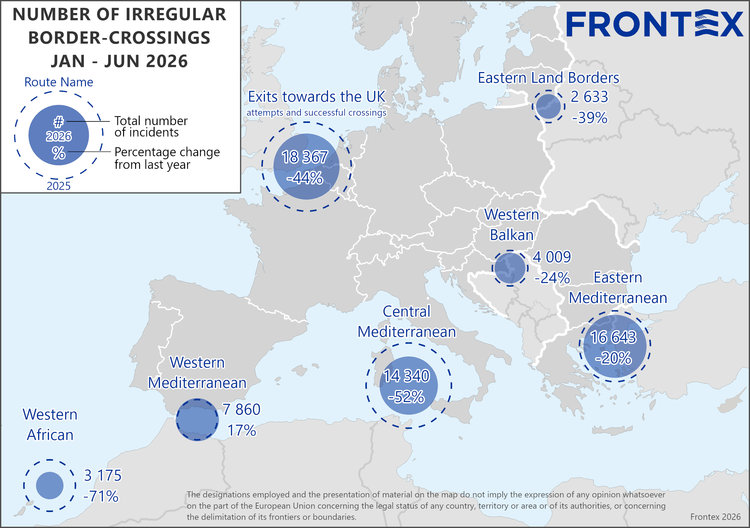
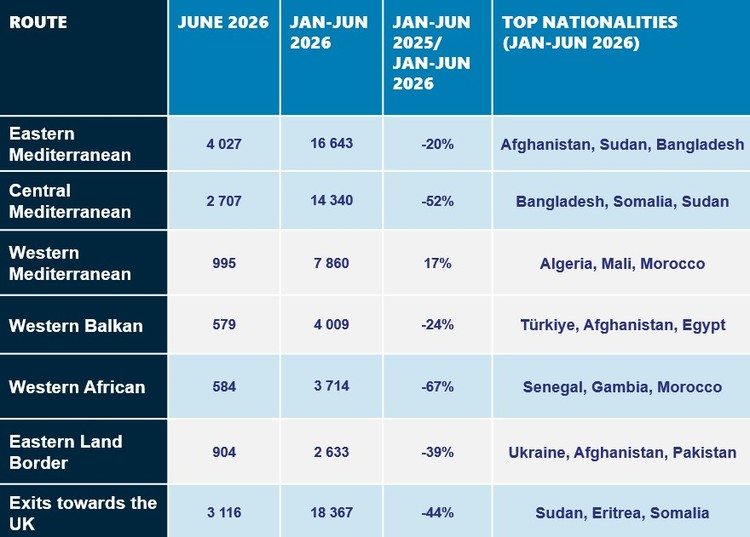
The number of irregular border crossings into the European Union continued to fall in the first six months of 2026, with detections down by 37% compared with the same period last year. More than 49 000 crossings were recorded, according to preliminary data collected by Frontex. The decline reflects sustained cooperation with partner countries and preventive measures in key departure states, which continue to reduce the number of boats setting out towards Europe.
The first half of the year also saw the entry into effect of the EU Pact on Migration and Asylum, which introduces a single, standardised screening process at the EU’s external borders. Frontex officers support member states in key steps of the new process, including establishing the nationality of arrivals, collecting biometric data and verifying documents.
“Fewer boats are setting out towards Europe, and that is the result of sustained cooperation with our partners in the region. But behind every number is a person, and people are still dying at sea. Our officers remain on the ground at the external borders, supporting member states and helping to save lives,” said Frontex Executive Director Hans Leijtens.
The Eastern Mediterranean and the Central Mediterranean were the busiest routes, together accounting for more than 60% of all irregular entries into the EU.
The Western African route saw the steepest decline, with detections down by 67% compared with the same period last year.
The overall number of irregular arrivals continues to fall, but the human cost remains high. According to the International Organization for Migration, nearly 1 300 people have lost their lives in the Mediterranean so far this year. Each of these deaths is a reminder of the risks people are pushed to take. Smuggling networks continue to send them to sea in overcrowded and unseaworthy boats, whatever the conditions.
The situation in the Middle East remains a source of uncertainty for the EU’s migration landscape. The ceasefire agreement reached in June raises hopes of a gradual stabilisation across the region, but the conflict has displaced large numbers of people, and its wider economic consequences risk reinforcing migration pressures in the region and beyond. So far, this has not translated into a significant change at the EU’s external borders, but Frontex continues to monitor developments closely.
With 3 800 officers present at the EU’s external borders, Frontex continues to support national authorities in safeguarding Europe’s borders and saving lives at sea.
The Eastern Mediterranean was the busiest route in the first six months of the year, with more than 16 600 crossings recorded, a fall of 20% compared with the same period last year. The corridor from Libya to Crete remained the most active on the route, accounting for more than half of all detections, ahead of the land borders with Türkiye and arrivals in the Aegean islands. Arrivals on the sea corridors from Libya and Türkiye are expected to continue rising as weather conditions improve over the summer.
The Central Mediterranean recorded around 14 300 arrivals, less than half the total from the same period last year. Libya remained the main departure point, where renewed clashes between armed groups in the coastal city of Al-Zawiya underlined the fragility of the security situation along the western coast. The main nationalities detected were Bangladeshi, Somali and Sudanese.
The Western Mediterranean was the only major route to register an increase, with around 7 900 detections, up by 17% year-on-year. Algeria remained the main departure country, and the Balearic Islands were the most targeted destination, accounting for nearly half of all arrivals on the route. The rise reflects a shift in smuggling routes, as stricter controls in Morocco and on the neighbouring Western African and Central Mediterranean routes have pushed more departures towards Algerian shores.
The Western African route registered around 3 700 detections, the steepest decline of all routes at 67%. Preventive measures implemented by Mauritania, and more recently by Senegal and The Gambia in cooperation with Spain and the EU, have significantly reduced departures. The flow remains volatile, however: favourable sea conditions drove a seasonal rise in departures towards the Canary Islands, and political uncertainty in Senegal may add to migratory pressure in the coming months.
Attempts detected on exit towards the UK across the Channel, which include both those who reached the UK and those prevented from leaving, fell 44% to some 18 400. The agreement between the UK and France signed in April is expected to further strengthen patrols along the French coast in the coming months.
* Note: The preliminary data presented in this statement refer to the number of detections of irregular border crossings at the external borders of the European Union. The same person may cross the border several times in different locations at the external border.