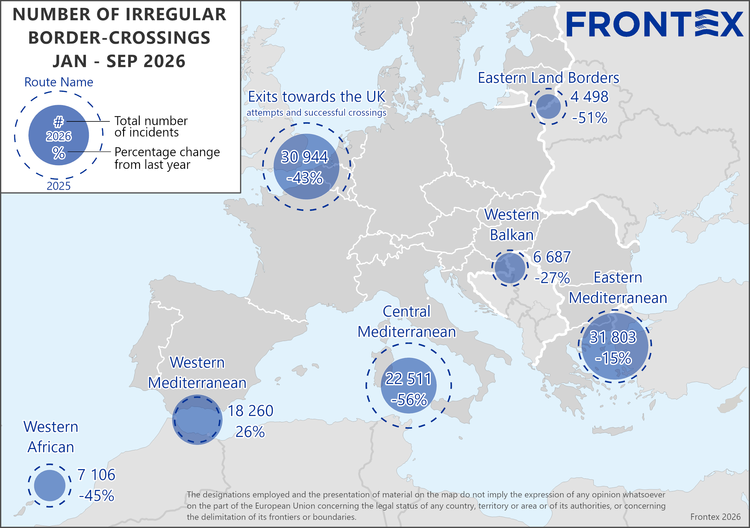
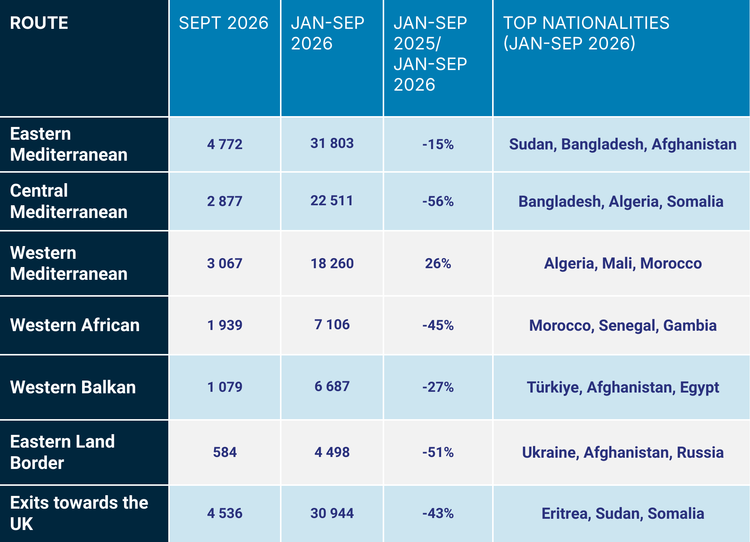
The number of irregular border crossings into the European Union continued to fall in the first nine months of 2026, with detections down by almost one-third compared with the same period last year. Just over 91 000 crossings were recorded, according to preliminary data collected by Frontex. The decline on nearly all of the major migratory routes reflects sustained cooperation with partner countries and preventive measures in key departure states, which continue to reduce the number of boats setting out towards Europe.
In September alone, some 14 300 crossings were detected, 28% fewer than in September 2025, although 11% more than in August as conditions improved along the main sea corridors. The period also covered the first full summer under the EU Pact on Migration and Asylum, which introduces a single, standardised screening process at the EU’s external borders. Frontex officers support member states in key steps of the new process, including establishing the nationality of arrivals, collecting biometric data and verifying documents.
The overall number of irregular arrivals continues to fall, but the human cost remains high. According to the International Organization for Migration, nearly 2 000 people have lost their lives in the Mediterranean so far this year. Each of these deaths is a reminder of the risks people are pushed to take. Smuggling networks continue to send them to sea in overcrowded and unseaworthy boats, whatever the conditions.
Developments beyond the EU’s external borders remain a source of uncertainty. Large-scale returns of Afghan nationals from Iran and Pakistan continue to shape movements towards Europe, and instability across the Sahel is driving departures towards both the Atlantic and the western Mediterranean. So far this has not translated into a significant change at the EU’s external borders, but Frontex continues to monitor developments closely.
With 3 800 officers present at the EU’s external borders, Frontex continues to support national authorities in safeguarding Europe’s borders and saving lives at sea.
The Eastern Mediterranean was the busiest route in the first nine months of the year, with around 31 800 crossings recorded, a fall of 15% compared with the same period last year. The corridor from Libya to Crete was the busiest section on the route, ahead of the eastern Aegean islands and the land border with Türkiye, with Cyprus accounting for a small share. Arrivals rebounded towards the end of the summer after a weather-related dip, and some 4 800 crossings were detected in September. The main nationalities detected were Sudanese, Bangladeshi and Afghan.
The Central Mediterranean recorded around 22 500 arrivals, 56% fewer than in the same period last year and the steepest fall of all routes. Libya remained the main departure hub, accounting for around three quarters of arrivals on the route, ahead of the Tunisian and Algerian corridors. The main nationalities detected were Bangladeshi, Algerian and Somali.
The Western Mediterranean was the only major route to register an increase, with around 18 300 detections, up by 26% year-on-year. The rise was concentrated on the land border, where detections have more than doubled, while arrivals by sea were up by 8%. Algeria remained the main departure country for sea crossings, with the Balearic Islands and the Spanish mainland the principal destinations. The Balearics remain the most dangerous entry point on the route. The main nationalities detected were Algerian, Malian and Moroccan.
The Western African route registered around 7 100 detections, down by 45%. Preventive measures implemented by Mauritania, and more recently by Senegal and The Gambia in cooperation with Spain and the EU, have significantly reduced departures. The flow remains volatile, however. Detections rose sharply in September, to around 1 900, four times the August figure, with departures reported from Morocco and from The Gambia towards the Canary Islands. The main nationalities detected were Moroccan, Senegalese and Gambian.
Attempts detected on exit towards the UK across the Channel, which include both those who reached the UK and those prevented from leaving, fell by 43% to some 30 900, with around 4 500 recorded in September. The main nationalities detected were Eritrean, Sudanese and Somali. Smuggling networks made increasing use of so-called mega dinghies, with a record 230 people, including more than 20 children, reaching the UK in a single inflatable boat in August. The agreement between the UK and France signed in April is expected to further strengthen patrols along the French coast in the coming months.
* Note: The preliminary data presented in this statement refer to the number of detections of irregular border crossings at the external borders of the European Union. The same person may cross the border several times in different locations at the external border. Frontex figures are compiled from data reported by national authorities. Data for the Western Mediterranean land route for 30 and 31 July are under review by the respective Member State and are not yet included.