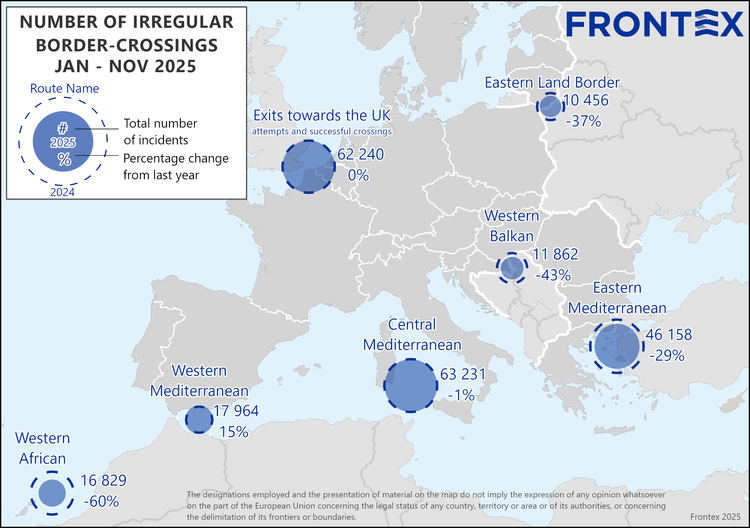
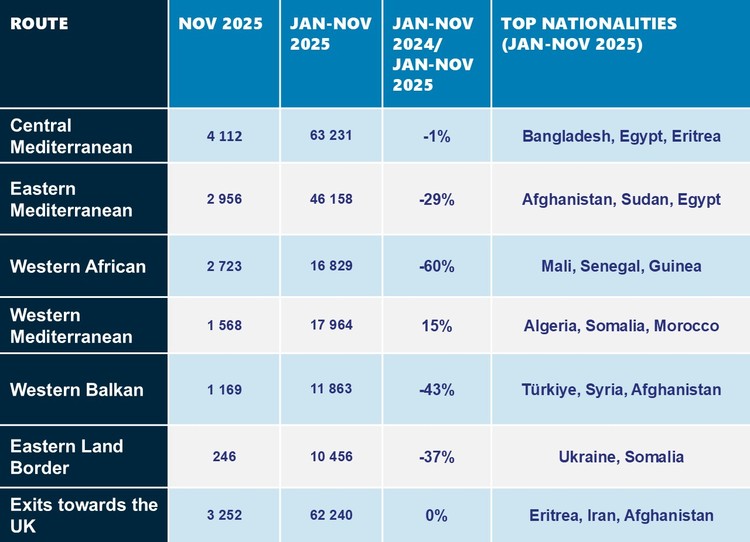
Irregular entries into the European Union dropped by 25% in the first eleven months of 2025 to just over 166 900, according to preliminary data from Frontex, the European Border and Coast Guard Agency.*
Across Europe, more than 3 500 Frontex officers continue working alongside national authorities to safeguard the EU’s external borders.
In the Central Mediterranean, over 63 200 arrivals were detected between January and November 2025 - essentially unchanged from the same period last year. Libya continued to dominate as the primary departure point, responsible for more than 90% of all arrivals on this route, with smaller numbers departing from Tunisia and Algeria.
In the Eastern Mediterranean, irregular crossings dropped by 30% to nearly 46 200. Yet the Libya-Crete corridor remained an active corridor in November, with detections surging by 260% in the first eleven months of 2025.
On the Western Mediterranean route, irregular crossings climbed by 15%. Algeria remained the central driver of migration here, accounting for more than 70% of arrivals. Algerian citizens and Somalis were the main nationalities registered using this corridor.
The Western African route recorded the steepest decline of the main migratory routes to the EU, plunging by 60% to just over 16 800 detections. Most of the people registered on this route were nationals of Mali, Senegal and Guinea.
Despite the overall reduction in irregular migration, the human toll remains severe. The International Organization for Migration estimates that more than 1 700 people have lost their lives attempting to cross the Mediterranean Sea so far this year.
Crossings toward the United Kingdom via the Channel remained broadly stable compared with 2024, with more than 62 200 crossing attempts recorded in the first eleven months of 2025.
* Note: The preliminary data presented in this statement refer to the number of detections of irregular border crossings at the external borders of the European Union. The same person may be detected crossing the border several times in different locations at the external border.